Written on Monday, 16 September 2013 by Unknown
Nowadays businesses associated with the professional services sector have switched to social technology platforms to maintain competitiveness within their selective industries.
Last week, we discovered how the non-profit organization from the social sector, ONE meets their goals and objectives through social technology, receiving the benefits of using social media that followed. Today we probe into how the professionals benefit from implementing social technologies.
Cognizant, professionals in IT solutions and consulting
Founded in 1994,
Cognizant is a world-class IT firm leading in today's business and technology services to help clients shift towards an advanced IT infrastructure future for;
maintaining ahead of other competitors.
Cognizant 2.0 (C2) is a service provided by the company to
share knowledge and efficiently manage projects across the globe to delivery their clients the most cost-effective and comprehensive, end-to-end, advanced IT solutions. Through this service, Cognizant outsource specialized skills from a broad talent pool from across the globe to solve any problem through C2. Cognizant's new social media tool helps company continue growth, compete with outsourcing giants such as Accenture, IBM. C2 can be considered a social platform but for
enterprise use.
You can see their service, C2 in action below.
Cognizant on current social media technologies
Their comprehensive applications of a variety of social media technologies include
Twitter,
Google+,
Facebook and
YouTube. Let’s look at how each social technology leverages value within Cognizant’s business functions based on the Mckinsey report.
Marketing and sales
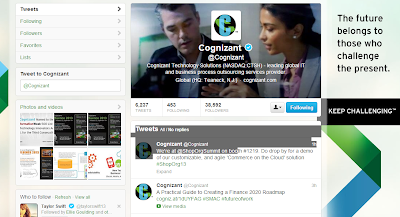
Cognizant uses twitter to market the value of the services they provide by posting quality success stories of organizations implementing
Cognizant solutions. This influences potential clients into considering using Cognizant based off positive feedback from other clients and assures that clients will achieve their IT innovation goals with Cognizant. You’ll also notice their use of Facebook include Business-2-business (B2B) communications and interactions.
Customer service
Like other organizations that adopts social technology, Cognizant provides customer care through twitter as a way of addressing their clients for technical issues or complaints about their service.
Enterprise-wide levers (Collaboration and communication)
Cognizant collaborates and communicates through the use of their own unique social technology platform, C2, to improve collaboration and communication between staff within their organization or when improving their client's current processes. This allows employees at Cognizant to be able to match talents to a specific task.
These social media technologies together effectively contributes to value across the organization at Cognizant and for their clients.

Posted in
blogging,
business,
cognizant,
companies,
enterprise,
enterprise 2.0,
foundation,
IBM,
INB346,
QUT,
social media,
Social technology
|
Written on Thursday, 22 August 2013 by Unknown
Last week we discussed how Commbank leverages the values and benefits of social media, this week I’ll identify some of the legal risks of using social media applicable to Qantas and discuss what the Aussie airline company’s Social Media Policy should address.
Here I will list the top five risks of using social media relevant to Qantas:
1. Reputation management
“social media is your greatest reputation risk because it is trusted, immediate, global and forever.” – Geoffrey Stackhouse
This quote is most relevant to Qantas as a competitive airline company. Social media has the power to quickly transform a company’s reputation on it’s head by creating negative publicity. For instance, if a customer posts an inappropriate comment on Qantas’ twitter page and a Qantas representative responds to the comment in a negative manner.
2. Security Issues
There is always the risk of having hackers, data or identify theft, spyware and bugs which could potentially ground Qantas for good. With this in mind, there’s also the risk of leaking confidential information about the company.
3. Engaging in two-way dialogue and potential criticism
While there are some happy customers there are always the risk of dissatisfied ones ready to voice their criticism onto Qantas social media platforms.
4. Trust as part of the culture
There needs to have visible level of trust for Qantas employees to be able to use social technology successfully. If there is no trust as part of the culture of the organization, then this could pose as a risk to social media for Qantas.
5. Wasting company time
It can be addictive and easy for a Qantas employee to be at risk of spending too much time, compromising their work efficiency and thus the organization’s business operations.
So I have just stated Qantas’ risks associated of using social media but how should they address these risks so they are dealt with in a timely manner? Below are the Social media policies in which Qantas should adopt:
- A communication approval
process involving senior level management to control defamation from
affecting the airline. Don’t allow new front-line employees full control
as their lack of experience could cause irreparable damage.
- Work with the IT
department or hire a professional to ensure proper privacy and security
settings are in place. This essential policy will ensure that the protection
of confidential information are in place to avoid falling into the wrong hands
of a cyber-thief.
- Carefully
monitor the social media platforms such as twitter and Facebook to quickly
identify negative feedback and address it before it gains support.
- Create an
extensive training program highlighting the do’s and don’ts when using social
media platforms. This is most applicable to all staff who are representing
on behalf of Qantas. They need to be aware of how to conduct themselves appropriately
while connecting with their customers.
- Monitor what
website employees visit and how much time they spend on them. If an
employee isn’t as productive or spends too much time procrastinating from work,
have human resources pep talk with that employee on how to use their time on
social media effectively.
For an example of a social media policy, here’s a short,concise and to the point example by ABC©.
Want to know more about proactive measures of using social
media? Watch this intuitive video below (thank you human services for allowing
me to share this)
Posted in
blogging,
blogs,
business,
companies,
enterprise,
INB346,
Qantas,
social media,
Social technology,
twitter,
university
|
Written on Friday, 16 August 2013 by Unknown
A study in
McKinsey’s report identified the benefits and values associated with organizations implementing Enterprise 2.0 using the
10 Social Technology value levers (as shown below). These levers are present in multiple functional areas of the business (also known as the business value chain).
Last week we discussed how the
Wikinomics business model principles applied to businesses using enterprise 2.0 technology such as Starbucks and StacksOverflow. Today we look at how Commonwealth Bank uses enterprise 2.0 tools to leverage the product development and customer service functions for their business.
They’re SOCIAL on social media!
Like Starbucks, Commonwealth Bank (or commbank) has
multiples modes of interaction between its customers and key staff members so they could achieve as much feedback and ideas for improvements on any particular product or area of
service as possible. They’re connected to just about all social media channels that you could think of… from
Facebook to
Youtube to
Google+ and their most recent,
blogging.
More on Commbank’s social media strategy can be seen in this clip below.
1. Product development (Customers are the co-creators for products)

Commbank provides a livespace community forum, called
IdeaBank where customers can post, vote or discuss with other customers within the community the ideas which could relate to existing products or products (or services in some cases) that they wish to see modified or developed in the future. Customers can vote on the likelihood in which they wish to see an idea come into action. This is the usual process for product development via social media interaction.
Image by
Expounder with cheese
So in essence, Commbank listens to their customers and what they would like to see changed or developed and implemented.
2. Customer service
Similar to other facebook pages that you might find for businesses, Commonwealth bank sports a
support community page for:
Ö Real time search for addressing problems with customers
Ö Community building, not just for selling their products but instead as a way for building a community-minded philosophy
Ö As a method for interacting with bank customers about their products using this social media channel, and
Ö Enabling transparency by allowing only key staff members, such as the bank manager, to answer questions directly to customers via a community page.
 |
Image by Commbank
So I believe that Commbank has set the bar for other major banks to up their game when it comes to providing a strong community and a customer based support network or simply by reaping the priceless benefits and values of using social technology. A big thumbs up for Commbank!
|
Posted in
banks,
blogging,
blogs,
business,
CBA,
commonwealthbank,
companies,
enterprise 2.0,
INB346,
QUT,
social media,
Social technology,
university
|
Written on Wednesday, 14 August 2013 by Unknown
Hey guys,
Back again to post this week's topic but first I want to thank those who shared my first post. May your day be showered with skittles (no not really..) ON with this week’s topic for today:
Working with Enterprise 2.0!
Examples of companies achieving their business objectives through the use of
Enterprise 2.0 principles and the relation
with Wikinomics business models”
For this week week’s activity, I'll be providing two examples of companies which use Enterprise 2.0 tools in a significant way to achieve their business objectives thus growing their business. How these examples relate accordingly to the Wikinomics business model principles (Peering, Being Open, Sharing and Acting Global) will be analysed.
[1] STACK OVERFLOW (& Stack Exchange)
 Founded in 2008, Stack Overflow (one of Stack Exchange’s network of Q&A websites) provides a question and answer open-site for professional and passionate programmers. Any user can ask or answer a question and the best answer is voted to the top similar to how top comments work on Youtube.
Peering
In relation to Stack’s website, its primary function is to collaborate with experts to the inexperienced in programming where questions about the various uses of programming are answered in a calm and collective environment. Also featured on the Stacks website is careers2.0, where job seekers can look for work involving programming nearby.
Openness
Stacks Overflow website is open for all, from the passionate to those who are new to programming. There are no visible boundaries as to who could ask or answer a question.
Sharing
On the mothership of Stacks Exchange website (or Stacks) provides newsletter subscriptions based on what the user is interested in. There are subscriptions from Arts through to Technology. This is a simple way that users can keep up to date with the latest top questions answered.
And of course the entire concept of a Q&A community is a form of sharing information. Stacks also shares a community blog with their users to discuss from a range of day-to-day topics.
Acting Global
Stacks has yet to implement a global strategic objective which will incorporate launching new sites to the Australasia region. As of November 2012, there are 105 separate sites and over 64 million unique monthly visitors and is continuously growing.
[2] STARBUCKS
Yes, even Starbucks has their own twitter account to engage with the community for any queries, complaints or replying to any mentions of Starbucks, all monitored and managed by Brad Nelson. Starbucks through the use of social technology via Twitter is more than just a Q&A. The coffeehouse chain now hosts a crowdsourcing site, called My Starbucks Idea where customers are able to submit their innovative idea and have them rated by other customers. Again, let’s look at how the Wikinomics business model applies.
Peering
In regards to the innovative customer idea input site, this provides a strong peered/shared environment amongst the consumer community. If I were to present an idea on that website, I would be able to receive immediate feedback from other consumers of the effectiveness of my idea.
Openness
As one of the most sought coffeehouse chain in the market, Starbucks not only sells coffee and interacts with their customers but they also have a global strategic objective of being green, giving back to thepeople via community service and ethical sourcing. Starbucks conducts their own environmental projects in order to improve their reputation for potential investors.
Sharing
Starbucks' concept of the “My Starbucks Idea” website assists staff on how to improve their products or introduce new ones.
Acting Global
Starbucks is already renowned as the largest coffeehouse company in the world, with 20,891 stores in 62 countries. Their online presence and retail reputation allows consumers to remain satisfied and loyal with their favourite coffee brand and ultimately further improves the companies’ brand image.
Sadly this is the end of Wikinomics business process model applied to real world organisations. I hope you enjoyed this week’s blog.
To learn more about the Wikinomics central concept, click here.
Posted in
blogging,
blogs,
business,
companies,
enterprise,
enterprise 2.0,
howto,
INB346,
self-help,
social media,
university
|